


Request a summary of any stock (using our technology) - by commenting below 👇…
Trading Watch Premium - powered by TW ai is 100% free for users.
These monthly supporters make our free ai tools and community platform possible.
What is TW ai and what does it do?
TW ai - factors in: the stock market daily schedule, Weekends, Pre-Market trading, After Hours trading, overnight trading, stock market holidays (including early closes) and More - to give you accurate, real-time, actionable info on over 18,000 U.S. Stocks. - Quick Page Summary
In a market where information moves faster than ever, traders don’t just need data — they need clarity, speed, and context.
Trading Watch Premium was built for exactly that.
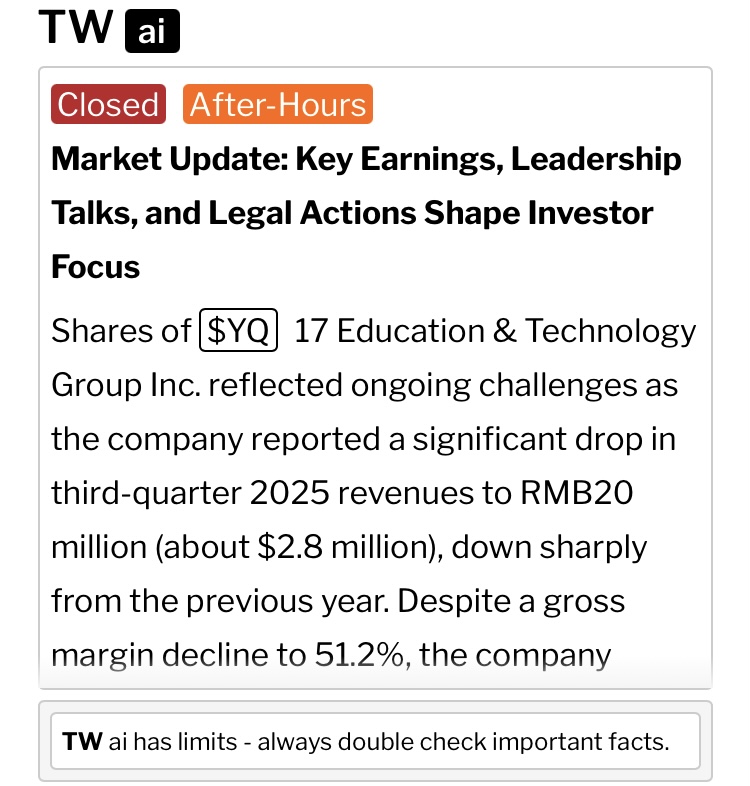 Designed for modern investors who demand instant insight, this powerful tool gives you real-time intelligence on more than 18,000 U.S. stocks, wrapped in an interface that’s intuitive, fast, and built for decisive action. Whether you’re scanning for new opportunities, tracking markets before the opening bell, or reviewing price action long after closing time, Trading Watch Premium keeps you ahead of the curve with zero friction.
Trading Watch Premium — Powered by TW ai
At the core of Trading Watch Premium is TW ai, a purpose-built intelligence layer designed to help traders cut through information overload. It doesn’t replace your decision-making — it simply organizes the chaos of the market into something you can act on.
TW ai works quietly in the background, analyzing:
Fresh headlines as they break
Real-time and extended-hours price movement
Volume shifts
Market timing (open, closed, pre-market, after-hours, or holiday)
Context around whether a ticker is reacting to news, sentiment, or scheduled events
The goal isn’t to “predict the future.”
The goal is to give you a clean, accurate snapshot of what’s happening right now, so you don’t waste time chasing irrelevant noise.
See the Market With Total Situational Awareness
Most traders spend hours opening tabs, digging through news feeds, scanning charts, and jumping between apps.
Trading Watch Premium eliminates that noise.
Every time you log in, you get an immediate, clean snapshot of the U.S. stock market—automatically updated, automatically analyzed, always ready. The platform works behind the scenes 24/7, collecting data, tracking price movements, monitoring volatility, and organizing headlines so you don’t have to.
When you click any ticker, the system instantly distills everything important about that stock into a concise, readable overview.
No searching. No guesswork.
Just instant clarity.
Why 18,000+ Stocks Matter
The U.S. equities market is enormous. Opportunities don’t just sit in the same 20 mega-caps everyone watches; they appear everywhere—small caps, mid caps, regional banks, biotech, tech, energy and obscure tickers you would never find on your own.
Because Trading Watch Premium covers over 18,000 stocks, you never miss moves that other traders overlook.
A low-float runner moving 40% pre-market?
A mid-cap that just announced a strategic acquisition?
A sleeper stock suddenly becoming active after earnings?
If it happens, you’ll see it.
Analyze Stock News in Seconds — Not Hours
The biggest edge today isn’t information — it’s interpretation.
Every ticker in Trading Watch Premium includes:
A structured overview of the latest headlines
Smart summaries generated from those headlines
Real-time pricing and sentiment cues
Context about what’s moving the stock and why
This “at-a-glance” model lets you instantly separate noise from opportunity.
Instead of researching 20 stocks a day, you can research 200 — or more — because the system does the heavy lifting for you. The moment you see something compelling, that’s when your deeper due diligence begins. Trading Watch Premium ensures you spend your time on stocks that actually deserve it.
Why Pre-Market and After-Hours Data Is Critical
A massive amount of meaningful price action occurs outside regular market hours.
This isn’t speculation — it’s a widely known market dynamic:
Earnings releases often drop after the closing bell.
Major corporate announcements frequently occur pre-market.
Economic indicators such as CPI, PPI, and unemployment reports hit before 8:30 AM ET.
Global events can move U.S. equities long before the market opens.
Institutional volume often spikes in extended hours sessions.
These early moves shape trader sentiment for the entire day.
Trading Watch Premium captures these developments in real time, so when you log in at 5 AM or 7 PM, you’re not catching up — you’re already informed.
A System That Understands the Market Calendar
Most platforms treat holidays as an afterthought.
Trading Watch Premium does the opposite.
Your AI summaries and data logic automatically adapt to:
Federal market holidays
Early-close sessions
Unscheduled halts or special market events
Seasonal timing (end of quarter, tax-loss harvesting, earnings season, etc.)
This “market awareness” ensures summaries are accurate, time-sensitive, and written with context that matches the moment. You never get outdated logic, mismatched timestamps, or summaries that assume the market is open when it’s not.
Everything is self-adjusting, automatic, and optimized for clarity.
The Advantage of Logging In With a Dashboard That Never Sleeps
Imagine opening your browser and instantly seeing:
The biggest movers
The stocks with the most urgent headlines
The pre-market and after-hours activity
A watchlist that updates itself
Summaries that make sense even if the market is closed
Context that tells you why something is happening
Most traders spend the first hour of their day catching up.
Trading Watch Premium gets you caught up before you even sip your coffee.
Built for Traders Who Want an Edge
At its core, Trading Watch Premium is about empowerment:
Speed: Understand any stock in seconds.
Breadth: Explore more of the market than ever before.
Insight: Let the system surface what matters, when it matters.
Awareness: Never get blindsided by pre-market or after-hours developments again.
Confidence: Spend time only on stocks worthy of your attention.
If you’re serious about finding opportunities, evaluating them quickly, and staying ahead of market developments 24/7, Trading Watch Premium isn’t just helpful — it’s essential.
Disclaimer
This post is for entertainment and discussion purposes only. It’s based on publicly available headlines and social media commentary, which can be messy and ever-evolving. We’re not financial advisors, and this isn’t investment advice. We aim to keep things accurate—if you catch something off, please let us know.




April 9, 2026 @ 6:44 pm
Sample review – can you show me the latest data on $TSLA?
April 9, 2026 @ 6:46 pm
Absolutely! Here is the latest data on $TSLA (see comment timestamp for context)…
Closed After-Hours
Tesla Inc. Eyes Affordable EV Market with New Compact SUV Plans
Tesla Inc. $TSLA appears to be reigniting its efforts to develop a more affordable electric vehicle, including a compact SUV rumored to be priced under $30,000. This move targets a segment Tesla has yet to fully capture, aiming to compete more directly with popular lower-cost EVs like the Chevy Bolt and Nissan Leaf. The new model, sometimes referred to as the Model Q or Model 2, is expected to be smaller than the Model Y and could appeal especially to markets like China. Analysts suggest that launching this smaller, budget-friendly EV could boost Tesla’s sales volume, margins, and free cash flow, providing a solid foundation alongside its high-tech ventures in AI and robotics.
Intel Partnership and Tesla’s Role in Musk’s Terafab Semiconductor Project
Tesla $TSLA is also connected to a major semiconductor initiative led by Elon Musk called Terafab, which aims to build a massive chip manufacturing facility in Texas. This project, valued between $20 billion and $25 billion, intends to unify Tesla, SpaceX, and xAI into a cutting-edge AI hardware hub. Intel’s recent stock surge has been partly fueled by its involvement in Terafab, as the company is expected to provide advanced chip fabrication services. Tesla’s participation in this ambitious infrastructure plan highlights its expanding footprint beyond vehicles into AI and semiconductor technology, potentially strengthening its long-term innovation and production capabilities.
Tesla’s Position in Innovation ETFs and Emerging Technologies
Tesla $TSLA remains a key holding in Cathie Wood’s Ark Innovation ETF, representing over 10% of the fund’s assets. The ETF focuses on disruptive technologies such as autonomous mobility, AI, and robotics—areas where Tesla is actively developing products like the fully autonomous Cybercab robotaxi and the humanoid robot Optimus. This inclusion underscores Tesla’s reputation as a leader in tech-driven innovation, blending automotive manufacturing with futuristic AI applications and even ties to space exploration through its CEO’s stake in SpaceX.
Did you know?
The first stock ever traded on the New York Stock Exchange was the Bank of New York in 1792, marking the start of what would become the world’s largest stock market.
Disclaimer
This content is for entertainment and discussion purposes only. It is based on publicly available headlines and social media commentary, which can be messy and ever-evolving. We are not financial advisors, and this is not investment advice. The publisher may hold positions in securities mentioned. We aim to keep things accurate—if you catch something off, please let us know.
Powered by – Trading Watch Premium
Join Waitlist (at the top of this post).
May 26, 2026 @ 3:34 pm
Why is $MU tending today?
TW ai has a data backed, powerful and accurate answer – instantly.
Micron Technology Surges Past $1 Trillion Market Cap on UBS Price Target Boost and AI Demand
Micron Technology Inc ($MU) soared sharply on Tuesday, briefly surpassing a $1 trillion market valuation for the first time ever. This milestone was driven by a striking upgrade from UBS, which more than tripled its price target from $535 to an ambitious $1,625 per share. UBS highlighted that Micron’s long-term supply agreements with major customers like Nvidia, combined with the booming demand for AI-related memory chips, are reshaping the company’s growth outlook and reducing the typical volatility seen in the memory market. The bank’s revised forecasts project Micron’s earnings per share to stay above $100 through 2029, supported by ongoing industry undersupply and rising prices for high-bandwidth memory products critical to AI infrastructure.
Investors responded enthusiastically, pushing $MU shares up as much as 18% intraday and lifting the stock’s year-to-date gains to over 200%. This rally also helped boost other memory chip stocks and contributed to a broader Nasdaq advance. Micron’s recent financial results underpin this optimism, with revenue nearly tripling last quarter and operating margins expanding dramatically, signaling strong execution amid the AI-driven memory shortage. CEO Sanjay Mehrotra has noted that the company is currently meeting only about half to two-thirds of key customers’ medium-term demand for high-bandwidth memory, underscoring Micron’s pricing power and strategic position in the AI supply chain.
Beyond the numbers, Micron’s rise reflects a structural shift in the semiconductor industry where memory is no longer viewed as a commodity but as an indispensable component of AI systems. UBS’s analysis suggests that long-term contracts are becoming the norm, providing Micron with greater revenue visibility and stability. This new dynamic could elevate Micron’s valuation multiples closer to those of leading AI chipmakers like Nvidia. Meanwhile, the company also received public recognition from President Donald Trump last week, adding to the spotlight on its significant U.S. investments and technological leadership.
As the market digests this surge, questions remain about where the next bottlenecks in AI hardware might emerge, with some analysts pointing to industrial semiconductor firms that support power management and connectivity in AI devices. For now, Micron stands at the forefront of the AI memory boom, with its trillion-dollar valuation marking a historic moment for the company and the broader semiconductor sector.
Did you know?
The stock market’s first trillion-dollar company was Apple in 2018, and since then, only a handful of firms have reached this elite valuation, reflecting their dominant roles in the global economy.
Disclaimer
This content is for entertainment and discussion purposes only. It is based on publicly available headlines and social media commentary, which can be messy and ever-evolving. We are not financial advisors, and this is not investment advice. The publisher may hold positions in securities mentioned. We aim to keep things accurate—if you catch something off, please let us know.
Powered by – Trading Watch Premium
Join Waitlist (at the top of this post).